
Engineering
Capital Projects Underway
Projects Schedule. For additional information about the projects below, please reach out to publicworks@portofpt.com.
Boat Haven Boatyard Stormwater Improvement
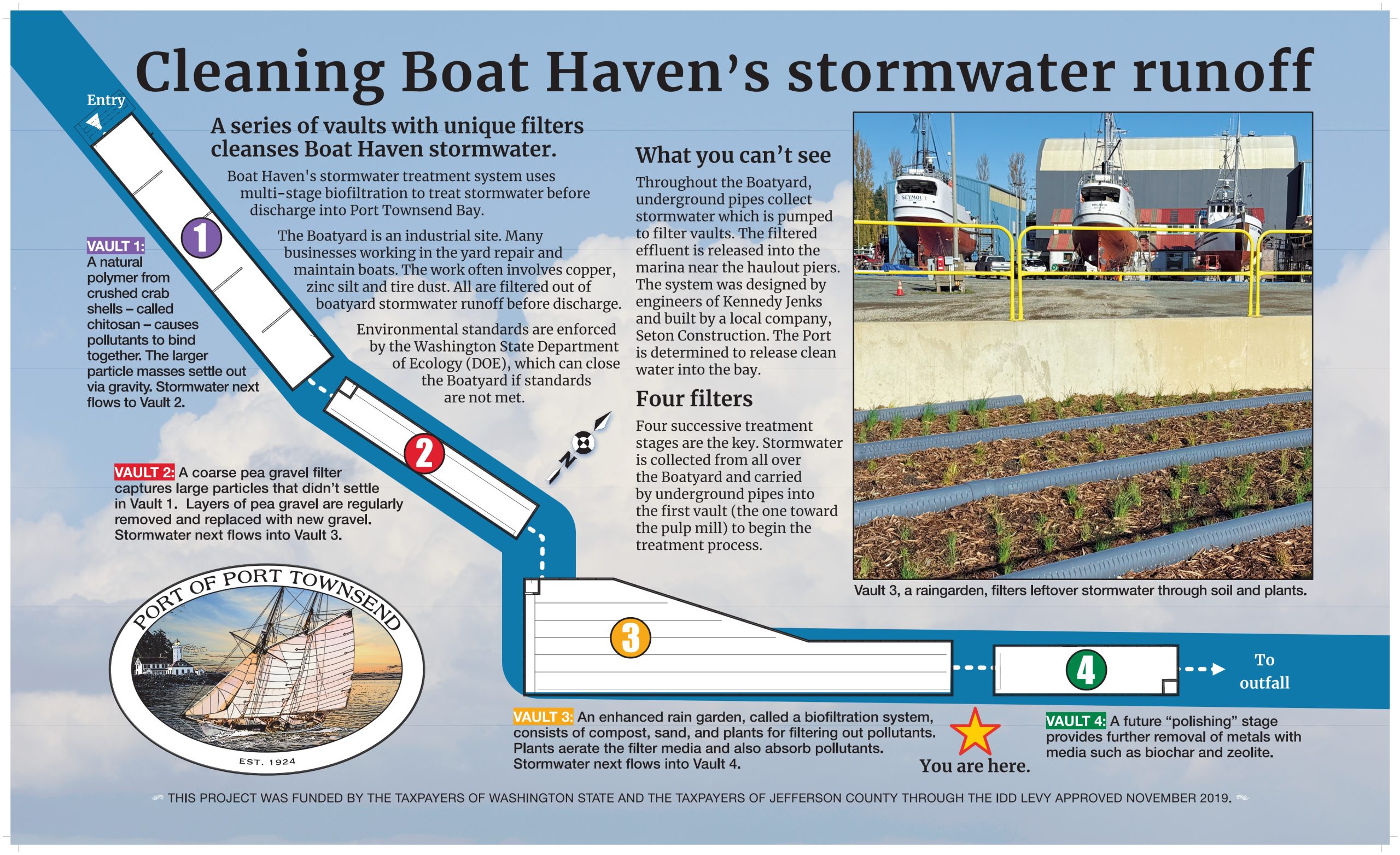


Background


Boat Haven Boatyard is Washington State’s largest open and publicly accessible yard. The Port operates Boat Haven under the Boatyard General Stormwater Permit (BGP) administered by the Washington State Department of Ecology (DOE) under the Federal Clean Water Act (2021). Maintaining compliance with the conditions of the BGP is a necessary prerequistite to preserving the more than 400 jobs directly dependent upon Boat Haven, and 1,154 jobs county-wide. Failure to meet these requirements can result in fines of $10,000 per day.
Boat Haven’s stormwater infrastructure was originally constructed in 1996 as a conveyance system only, not treatment. However, as DOE regulatory requirements have increased (e.g., decreased allowable discharge limits for copper, new testing requirements for pH, turbidity, and oil) in more recent years, the system has been incrementally modified to incorporate treatment components. Today, substantial system improvements are urgently needed to ensure effective treatment and that the Port achieves regulatory compliance with the BGP to safeguard the jobs that depend upon this critical infrastructure.
This project construction is a centralized and automated four-stage stormwater treatment system serving the approximately 30-acre boatyard with additional treatment capacity to accommodate planned expansion of the boatyard to the southwest. These improvements will address anticipated future reductions in acceptable discharge limits by DOE.
Gardiner Boat Launch
Gardiner Boat Launch is the only boat ramp with public access to Discovery Bay. This project replaced the deteriorated boat launch facility with a new ramp and handling float, provided ADA access and improving the ease of use of the facility. Construction completed 2025.


Boat Haven Main Breakwater Project
Boat Haven Marina is the heart of Jefferson County’s working waterfront and maritime culture. It is home to more than 100 wooden boats, the USCG Cutter Osprey, the local fishing fleet, staging for all vessels coming and going from the Port Townsend Boatyard and marine fueling. This project would facilitate dredging of the entrance to Boat Haven Marina to address shoaling that is limiting access during certain tides for certain vessels.
The eastern 600 feet of the main breakwater at Boat Haven was originally constructed in 1935. This portion of the breakwater suffered considerable damage during a storm on December 20, 2018, in addition to similar damage that occurred in 2016. The majority of federal permits were issued in 2022, and in early 2024, the Port secured an $800,000 grant from the Maritime Administration (MARAD) of the USDOT through their Port Infrastructure Development Program (PIDP). Repair construction is planned.


Sea Level Rise Project
The Sea Level Rise Project aims to provide protection for Boat Haven and the low-lying “Flats District” (from the bluff west of Boat Haven northeastward to the Port Townsend-Coupeville Ferry) from coastal flooding due to king-tides and severe weather events. The project is to follow the City of Port Townsend’s Shoreline Master Program and will aim to incorporate pedestrian access referred to as the “waterwalk” along the entire project’s coastal frontage. In 2024, the Port retained KPFF Consulting Engineers to complete 10% preliminary design plans with the expectation of submitting a grant application for the Building Resilience in Communities (BRIC) program through FEMA in hopes of securing funding for design and construction.
FEMA canceled the BRIC program in April of 2025. The 10% design and benefit to cost analysis is complete as of June of 2025. The preliminary design may serve as a platform for a future grant application for a yet to be determined grant program to address the critical need for coastal flooding protection for the Boat Haven Marina and Boatyard and the Port Townsend Flats District.


JCIA Fuel Operation
Project currently under construction. We are targeting to have the system operational by July 1, 2026.


JCIA Rural Light Industrial Park

 Since completion of a US Department of Commerce-funded feasibility study in 2011, the Port has sought to establish a rural light industrial park at the JCIA. Originally, this effort was focused solely on one 24-acre parcel located south of Runway 9/27 and north of Four Corners Road (APN 001331005). However, in 2024 the Port worked closely with Jefferson County and the FAA to successfully expand the “Airport Overlay-III” zoning designation south of the runway. This zoning change permits non-aviation-related light industrial development over a wider area and is intended to create new opportunities for businesses to enhance the community’s economic vitality.
In March of last year, the Port entered a 30-year land lease agreement with the Jefferson Timber Cooperative (JTC) for two parcels recently included within the Airport Overlay-III designation that are situated south of the “27 end” of the runway and north of the Jefferson Transit facility (APNs 001332013 and 001332017). JTC is presently using the leased land for their wood processing and sales operation. However, because of the lack of on-site infrastructure, JTC’s use is currently limited to storing and scaling logs, grading and storing lumber, and fulfilling wholesale and retail orders. Nevertheless, JTC’s ultimate objective is to develop the site as an Industrial Symbiosis Park, where uses collaboratively and symbiotically complement one another, upscaling the waste of one industrial process into the finished product of another.
To achieve the long-term vision of establishing an Industrial Symbiosis Park on the site, several basic infrastructure improvements must be made: extending three-phase 480V power to the site; providing potable water supply as well as fire flow; developing access from SR 20; and creating building pads and an internal circulation road on the site.
Point Hudson Shoreline


 Soft shore armoring to address erosion.
Point Hudson Roofing


 Point Hudson was originally constructed by the U.S. Department of Treasury as United States Quarantine Station Port Townsend. Between 1936 and 1956 it was also home to the Coast Guard, Navy and Army. The Point Hudson Energy Efficiency Improvement Project replaces existing oil heat, baseboard electric heat and portable AC units with modern high efficiency heat pump and mini split HVAC systems; replace windows, doors, improve insulation; update electrical and plumbing systems.
The Point Hudson Preservation Plan (2020) specifies the remodeling of 11 Point Hudson Buildings in order to prolong the economic and structural viability of the campus well into its second century of existence. The Port of Port Townsend was awarded Heritage Capital Program (HCP FY 25-27) funding for the Point Hudson Roof Replacement and Asbestos Abatement Project in the amount of $1,000,000 for the re-roofing of nine buildings at Point Hudson, including Building #15. In addition to the roof replacement work currently underway, several buildings have already experienced significant upgrades (Building #5 Cupola, Building #2 Duplex, and Building #12 Pavilion), while others are scheduled and funded for upgrades this year (Medical Officer in Charge Building #1 aka Commander’s Beach House).
As Point Hudson nears its 90th anniversary after dedication as a national Quarantine Facility in 1936, its original asbestos-containing transite roof tiles are at the end of their service life. Nine buildings on the north and east side of the marina harbor require replacement, with seven of those buildings requiring asbestos abatement prior to new roof installation.
The project entails the asbestos abatement of seven buildings including the Cupola, Duplex, Commander’s Beach House, Hospital Building (WDFW), Pavilion, Main (Shanghai, Point Hudson Grill), and Salish Grill. The project includes the demolition of existing roof materials for the Cupola Annex and the Old Moorage Office currently occupied by Chums and Sea Grant. New standing seam metal roofs will be installed for all nine buildings over a new layer of plywood and new waterproof underlayment.
Herb Beck Marina
Marina improvements were grouped under a single U.S. Army Corps of Engineers permit. Improvements included: Dock, pile & gangway replacement, marina slope armoring, breakwater restoration, entrance dredging, boat ramp replacement, environmental mitigation for these improvements is being provided through: A culvert removal project on Naylor Creek located at the Port’s Shorts Family Farm.
A recent court ruling in March 2026, has halted federal preparation of Endangered Species Act consultations. There is uncertainty regarding when federal permits will be issued, whether the Naylor Creek mitigation project will proceed. Except for the boat launch replacement, the following improvements still require funding: Dock, pile & gangway replacement, marina slope armoring, breakwater restoration, and entrance dredging.
Design of the new Boat Launch is nearly complete. Local permitting with Jefferson County is currently underway. The Port plans to advertise for construction bids in June 2026. Engineer’s estimate is $1.1 to $1.3 million. Construction is expected to begin in the Fall of 2026. Advertising for bids and constructing are contingent on ESA Section 7 permitting being completed.

Boat Yard - PT Bay Saltwater Estuary Project

Staff continue to advance an array of projects at Boat Haven intended to address off-site stormwater runoff, enhance wetlands and water quality, expand the yard for active marine trades use, and reroute the Larry Scott Trail (LST) along the western perimeter of the Port’s property to improve safety.
An element of this overall effort would realign the LST from the intersection of Haines Place and SR-20, along the northern and western limits of Boat Haven to the “leafwing” on the shoreline southwest of the Port Maintenance Building and the area referred to as “Wetland A”. The project is intended to encourage cyclists and walkers to use this route in lieu of traversing the heart of the industrial boatyard, thereby improving public safety and reducing recreational/industrial use conflicts. That portion of the LST south of Wetland A and west of the 300-ton washdown pad would still be retained as a trail spur for wildlife viewing but would no longer be a formally designated segment of the LST. Advancing this effort will require concomitant amendments to LST 1997 Interlocal Agreement with Port, City and County and related legal documents (e.g., quitclaim deed and/or easement).
Short Farm
THE SHORT’S FAMILY FARM: PLANNING FOR THE FUTURE: Maintain Public Access, Continue Habitat Improvement Efforts, Future Uses Comply with Jefferson Land Trust Easement and County Plan/Code, and Continue to Advance Port Key Capital Improvements
Option #1 – Funky Boatyard: This option is akin to the historical development of the Port Boat Haven property. All land and buildings are listed, and the Port responds to the market for those premises. These responses and subsequent leases/agreements will direct the Port on infrastructure development and projects. The improvements to the property occur incrementally and organically.
Option #2 – Regenerative Farming & Permaculture Education Center: The Port would seek to showcase and program the farm as an educational center for sustainable food production techniques. The Port would partner with local farmers and permaculturists and develop and use the Short’s Farm as an educational center showcasing both regenerative farming permaculture design principles. In building envelope #1, the original barn and farmhouse would be rehabilitated as an event center to host community events, seasonal farmer’s and holiday markets, and other programs aligned with the vision. Areas on the west side of Chimacum Creek would devoted primarily to regenerative farming, and areas on the east side of the creek used for permaculture production.
Option #3 – Agricultural Incubator Location + Food Hub: This option imagines that significant portions of the farm would be identified as “incubator space” to provide new farmers with access to land at favorable rates for a defined period (e.g., up to five (5) years). This would take the form of a master lease for sizeable portions of the farm to a nonprofit who would then sub-lease plots. Typically, however, a key feature of incubator farms is access to shared equipment, training and mentorship, and assistance in connecting new farmers to markets and community supported agriculture programs. To offer this “full suite” of incubator support, an entity other than the Port would need to take the reins. Under this scenario, the Port’s role would be limited, although always willing and able to advance capital grant efforts and infrastructure improvements.
Option #4 – RFP for Master Tenant: This option imagines the Port undertaking a Request for Proposals (RFP) process for a master tenant for the whole property. This RFP will delineate Port goals and projects consistent with both the Farm Steering Committee Farm Plan and the baseline development outlined in this document. If a suitable tenant is identified, this would lead into a lease negotiation process which could have a variety of outcomes and implications, most significant of which are lease rate and required Port capital investments.


Sims Gateway & North Boatyard Expansion Project
Background and Project Description
In the summer of 2021, safety concerns related to electrical arcing from nearby high-voltage transmission lines to the aging poplars along Sims Way prompted a coalition of local governments to develop a plan to permanently separate the transmission lines from the trees, while accommodating boatyard expansion to the north in the process. This collaborative effort by the Port of Port Townsend, the City of Port Townsend, and Jefferson County PUD will include:
- removing the poplars on the south side of Sims Way adjacent to the Boat Haven Boatyard (PUD),
- moving the 115KV high-voltage transmission lines into underground conduits (PUD),
- building a new paved, ADA compliant sidewalk connecting the intersection of Haines Place and Sims Way to the existing sidewalk in front of the former Chamber of Commerce building (City),
- landscaping and planting new trees along the south side of Sims Way (City), and
- expanding the boatyard to the north by approximately 1 acre (Port).
In addition to resolving the danger of electrical arcing to the Lombardy poplar trees, boatyard expansion will also address the risk of electrocution to boatyard workers hauling and blocking boats with metal masts by removing overhead power lines in the yard. The additional space will provide an economic benefit to the community, too, supporting up to 10 additional family-wage marine trade jobs. The new hard surface sidewalk will also provide improved connectivity for pedestrians in the Port Townsend Flats District.
Timeline
2021-2024
- (2021) Local government coalition formed to address electrical arcing issues (PoPT, CoPT, PUD)
- (2021) Public Infrastructure Fund (PIF) grant awarded to project by Jefferson County
- (2022) Stakeholder group formed
- (2022) Plan approved by local governments in September
- (2023) Updates to the City’s Comprehensive Plan and amendment to the Gateway Development Plan
- (2023) Additional PIF funds awarded to project by Jefferson County
- (2024) Stakeholder group reconvened
- (2024) Detailed design begun for undergrounding of transmission lines, landscape architecture, and boatyard expansion
2025
- (April 2025) City of PT makes determination of non-significance (DNS) regarding SEPA application.
- (June 2025) Tree removal contractor selected by PUD.
Projected
- (Summer 2025) Tree removal along Sims Way.
- (Summer/Autumn 2025) PUD trenching and utility undergrounding begins.
- (Autumn 2025) Boatyard expansion construction begins.
- (Spring 2026) Landscaping & construction completed.
More Information
Please visit Engage PT for more information about this project, its history, and records of meetings and public engagement since 2021. You can also email the Port’s engineering staff at publicworks@portofpt.com. Please expect 1-2 business days for a response.